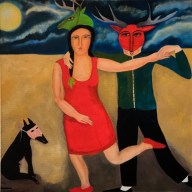
YES!!! I ACCEPT ALL COOKIES!!!IT’S OK (sort of)!!!
If you haven’t figured this out by now, I spend a lot of time on the Internet…doing research for the blog, reading the news, shopping, you name it! And more and more I am being asked to (forced to?) “accept cookies” on websites.
(An aside: while I busy myself on the internet, Andy busies himself trying to find the meaning of life by doing nothing. See today’s Andy’s Corner – if you’re not too busy.)
Our Brooklyn son was just here visiting (and working from “home”) for 2 weeks; he’s our tech authority, so asking about “cookies” was high on my list for him. But before he arrived I read this – badly titled – article in The Atlantic: Slouching Toward ‘Accept All Cookies’. Here’s a slightly-disturbing excerpt:
Even if not all of our information goes toward selling ads, it goes somewhere. It is collected, bought, sold, copied, logged, archived, aggregated, exploited, leaked to reporters, scrutinized by intelligence analysts, stolen by hackers, subjected to any number of hypothetical actions—good and bad, but mostly unknowable. The only certainty is that once our information is out there, we’re not getting it back.
I had to accept cookies to get to see this photo of Lou Montulli, the “cookie” term-coiner.
How did the word “cookie” ever get used for this annoying information-stealer? Lou Montulli, a young engineer at Netscape, coined the term around 1994.
Montulli writes, “I had heard the term “magic cookie” from an operating systems course from college. The term has a somewhat similar meaning to the way Web Cookies worked and I liked the term “cookies” for aesthetic reasons. Cookies was the first thing I came up with and the name stuck.“
Where did “magic cookie” originate? Maybe from the comic strip, Odds Bodkins, published in the SF Chronicle from 1969-70:
Once you’ve decided to accept cookies – consequences be damned – you need a cookie to accept. And we’ve got a winner!
Clearly, I accepted cookies way back when I was a Brownie. Do you adore my shoes, big ears, and toothless smile? How about those 1950’s kitchen curtains and vinyl-covered chair?Acme Dinettes; produced 1949-1959
Logically, my shared cookie recipe would have been for “Magic Cookies” (which is actually a very popular cookie recipe), but I ventured further.
I searched for “the most popular cookie recipe,” and the first one that came up, one that “tops them all” with over 7000 “likes” was from allrecipes.com – for Mrs. Sigg’s Snickerdoodles. Since our two grandsons (the last one just left home to begin his freshman year at UC Santa Cruz…sigh) have always been Snickerdoodle lovers, it seemed apropos to share my favorite snickerdoodle cookie recipe with you. Mine comes from the River Road Recipes cookbook, 1974 edition, published by The Junior League of Baton Rouge. And, would you believe, it’s almost identical to Mrs. Sigg’s! I hope you find them “acceptable.”
It all started when I looked at this topless photo of my grandson. I began to wonder about my “top.” When and why (I said to myself) did it happen that men get to show their nipples and women can’t? Isn’t this discriminatory? Shouldn’t I be outraged?
You can see my excitement at seeing our grandson’s nipples and bare upper body – though seeing the rooster tattoo is pretty exciting. Could it be a reincarnation of my childhood pet rooster, Pecker?
Because I was an English major, not a history major (sniff…those dying-off majors!), I figured that maybe historically that was just the way it played out. Women did not ever show their boobs; men could do whatever they wanted. BUT THEN…I did some research (probably like a good history major would do).
My research first reminded me of the huge numbers of bare-breasted women in famous art. The NYTimes just had a great article about how “New generations of women painters are challenging centuries of art history with their nuanced, empathetic renderings of bare-chested bodies.”
Admittedly, I had to look really hard to see the bare-breasted body in this painting.
If you need a refresher about breasts in famous art and throughout history, Medium.com has a brief but “revealing” article. My research indicates that there have been times when it was okay for a woman to bare her breasts but not her legs. Interesting. Maybe that was applicable to the famous statue of Venus de Milo – which you can see the next time you’re at the Louvre.
The statue is most-likely late Hellenistic, dating to c. 150 BC – c. 50 BC
Or you can go to The Art Institute of Chicago and see Salvador Dali’s Venus de Milo with Drawers.
Maybe when Dali did this in 1936 he felt boobs should be covered?
My curiosity about women baring breasts was titillated by analyzing two other famous paintings.
The Feast of the Gods by Bellini – begun in 1514. Was the “feast” the sight of the bare boobs or the food?
Analyzing Bellini’s The Feast of the Gods (housed at the National Gallery of Art in D.C.), one might surmise that while paintings could show such a bountiful display of boobs, that the average woman of that time would not have exposed so much. However, Wikipedia has this to say: “in many European societies between the Renaissance and the 19th century, wearing low-cut dresses that exposed breasts was more acceptable than it is in the early 21st century; bared female legs, ankles and shoulders were considered to be more risqué than exposed breasts.” You can check this site out to see some nice female portraits from that era.
BTW If you’re trying to figure out who’s who in that painting, HistoryToday.com states that the gods feasting include Amphitrite, in the center, along with husband, Poseidon (Neptune). Amphitrite is holding a quince, the symbol of marriage (and love and fertility).
A quince and Amphitrite and Poseidon
(An aside: if you want to be really amused and/or horrified, click on the link below (only if you’re over 18 🙂 ) to learn more about the god portrayed on the far right, lusting after the bare-boobed – and possibly drunk – Lotis. He’s identified as Priapus – god of fertility, vegetables, and male genitals. Another site notes Priapus was a protector of beehives, flocks, and vineyards. Multi-talented, for sure.)
My excellent CC English course on Shakespeare makes me a little more aware of Elizabethan England – when it was common for women to show one or both breasts in public. For upperclass women, it often was a sign of wealth – because the physical appearance of a woman’s boobs indicated she could afford a wet nurse for her children. Or if unmarried, her breasts’ appearance apparently confirmed she was a virgin (Queen Elizabeth I, the Virgin Queen, displayed her breasts frequently.)
Queen Elizabeth I
Harumph. So it appears we’re backsliding in regards to a woman’s freedom to bare her upper body?
Andy in today’s Andy’s corner suggests that women may not be backslliding in the bare boob department as much as I thought – at least under special circumstances; and that it’s beads rather than quince that that we should be thinking about.
The other famous painting with bared breasts that intrigues me is Liberty Leading the People by Delecroix. Basically, if and when I come back in another life…I want to come back as Marianne, the woman leading the people (all men?) in this painting of France’s 1830’s July Revolution. Can you blame me? What a great cause. What a great role-model. What a great outfit. What great boobs.
Liberty (aka Marianne) in Liberty Leading the People by Eugene Delacroix, 1830
The perfect conclusion to my historical research into bared breasts is the lawsuit brought in my hometown of Fort Collins, Colorado, a few years back. In 2015 the city barred women over the age of 10 from showing their breasts in public. Two women sued the city, claiming the law violated the 14th Amendment because it applied only to women. The case went the the 10th Circuit Court of Appeals – which in 2019 ruled against the city. Fort Collins decided not to appeal to the U.S. Supreme Court. Since that Circuit Court oversees 6 states there was – for a time at least – the possibility that women could legally go topless in Utah, Colorado, Wyoming, New Mexico, Kansas, and Oklahoma. But then here’s a map from GoTopless.Org which indicates that going topless is legal now in the majority of states but against the state law in Utah – and is not clearly a right in Oklahoma.
All of this is overwhelmingly complex to an English – but probably not History – major. If you’re confused and want to try to learn more about the status of toplessness in the U.S. today, here’s one of the better articles I’ve found.
Those who participate in Go Topless – or the #FreeTheNipple Movements – are gearing up for August 25, when GoToplessDay will be celebrated. But as long as I know I have the right to do what I want with my “top” here in California, I’m perfectly content to stay covered up in my sweatshirt, while cheering on the GoToplessDay participants
I can’t tell you how relieved my friends and family are.
I’m been thinking a lot about Anne Hathaway recently. And not the American actress, Anne Hathaway, who was born in 1982; rather I’m thinking about Anne Hathaway, wife to William Shakespeare, born in 1556. Anne married Shakespeare in 1582 when she was 26 – and pregnant. Shakespeare was 18 – and needed his father to okay his marriage. They were married 34 years – and were still married when Shakespeare died on April 23, 1616 – at the age of 52 (Anne lived another 7 years).
The 19th-century German print-maker, George Edward Perine, did this rendition of Shakespeare with his family. Anne is on the right, sewing.
Was theirs a happy marriage? Well, if you remember Shakespeare’s Sonnet 116, you’d think he was quite a romantic and surely must have known true love:
Let me not to the marriage of true minds Admit impediments. Love is not love Which alters when it alteration finds, Or bends with the remover to remove: O, no! it is an ever-fixed mark, That looks on tempests and is never shaken.…
Turns out that Shakespeare left his wife and children in Stratford-upon Avon around 1585 (their children, Susanna and twins, Judith and Hamnet, were about 3 and 1 at the time) to go to London with a troupe of actors. He returned home infrequently after that. Did he love Anne dearly – and his being gone was just a necessity of that day and time? Who knows.
Since it’s been 400 years since Anne’s death, a group of poets have put together an “Anne-thology” of poems about her which you might want to consider. And there’s a play, focused on Anne, being performed in Stratford-upon-Avon now – and this fall in London; it’s based on the 2020 novel which I loved, Hamnet by Maggie O’Farrell. Since almost nothing is actually known about the real Anne Hathaway, the book is clearly fiction.
Of course, you can’t think about Anne without also thinking more about William. He was born on the same day he died – April 23 – which is the same day Andy was born. Fortunately, Andy did not leave me in Fort Collins, Colorado, with our young children while he pursued his love of sociology at LSU in Baton Rouge. I got to go along (Anne Hathaway never went to London). And – VERY fortunately – Andy did not die at the age of 52. 🙂 Happily, Andy just celebrated his 80th birthday! And we celebrated the occasion with our family in New York City, seeing the just-opened Broadway play Fat Ham, which is a modern – and raucous – re-creation of Shakespeare’s Hamlet.
A scene from Fat Ham
And – before we offer up a delicious recipe that actually has some connections to Elizabethan England, let me remind you of this wonderful line from The Merchant of Venice. What could be a better wish for one’s 80th?
As for food, we know that in the theater pit of Shakespeare’s time, walnuts, hazelnuts, plums, cherries, peaches, raisins, mussels, periwinkles and crabs were often eaten. And we also know that the Elizabethan English loved “marchpane” – which we now call marzipan.
The Virtues of the “Compleate” Woman. Read it over…you’ll be glad you weren’t a woman back in 1615.
An excerpt from The English Huswife:
“To make the best Marchpane take the bset Jordan Almonds and blanch them in warm water, then put them into a stone mortar, and with a wooden pestel beat them to pap, then take of the finest refined Sugar well searst, and with it Damask-Rose-water beat it to a good stiff paste, allowing almost to every Jordan Almond, three spoonfulls of sugar, then when it is brought thus to a paste, ….”
The brand Odense is often recommended.
Our recipe for today uses almond paste, not marzipan. Both have similar ingredients – mainly sugar and almonds – but in different proportions. Almond paste is less sweet and has more almonds, so do not substitute marzipan in this recipe. I gave up frosting cakes a long time ago, so Andy is used to simplified birthday cakes.
If you’re wondering where Andy’s Corner is today, it isn’t. He’s too busy celebrating his birthday week with mirth and laughter. He “hath-a-way” of doing that!