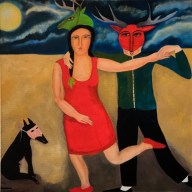
It’s Ann here today. Andy is in OurLittleCorner dotting and dashing.
The First Presbyterian Church in Fort Collins, Colorado, seems to have failed some of us. I wonder if you had attended Sunday school there in the 1950’s, as I did, you’d feel the same. Case in point: I have very limited knowledge of the Bible. Sure I know the major stuff, but so many of the Biblical details escape me. For example, I had no idea that the traumas involved with giving birth to my two children could be attributed to Eve (as in Adam and Eve). And I had no idea that when Andy bear hugs me and I occasionally feel a little weaker, a little smaller…somewhat diminished, Eve could also be to blame.

My King James version of the Bible, given to me in 1952 when I was 8 by our church’s minister, reads in Genesis 3:16 that God said to Eve:
“I will greatly multiply thy sorrow and thy conception;
in sorrow thou shalt bring forth children; and
thy desire shall be to thy husband,
and he shall rule over thee.”
The top selling Bible versions in the U.S. in 2025 were the New International Version and the New Living Translation. Here’s how Genesis 3:16 reads in each:
“I will make your pains in childbearing very severe;
    with painful labor you will give birth to children.
Your desire will be for your husband,
    and he will rule over you.” New International Version (NIV - released in 1978)
“I will sharpen the pain of your pregnancy,
    and in pain you will give birth.
And you will desire to control your husband,
    but he will rule over you.” New Living Translation (NLT - released in 1996)
(An aside: I like Eve having the God-given desire to have a little control in the NLT version. That’s also why I especially like this painting by Gustav Klimt: Eve represents the “radiant day”…and Adam the darker night! ).

You may be wondering why I’m thinking so much about Eve these days. Well, it started when I read the last short story in Amor Towles’s Table for Two. The story is entitled “Eve in Hollywood” and is a continuation of a story that began in Towles’s book Rules of Civility. Clearly Towles had the Biblical Eve in mind in penning this tale. Eve (in Hollywood – not in Eden) is protective of other women, always desiring to be in control – and incredibly strong and assertive with men. A “lady in waiting” concept does not sit well with her. A favorite poem of Eve’s is Shelley’s “Ozymandias.”
Ozymandias (1818)
I met a traveller from an antique land,
Who said: “Two vast and trunkless legs of stone
Stand in the desert. Near them, on the sand,
Half sunk, a shattered visage lies, whose frown,
And wrinkled lip, and sneer of cold command,
Tell that its sculptor well those passions read
Which yet survive, stamped on these lifeless things,
The hand that mocked them and the heart that fed;
And on the pedestal these words appear:
"My name is Ozymandias, king of kings:
Look on my works, ye Mighty, and despair!"
Nothing beside remains. Round the decay
Of that colossal wreck, boundless and bare,
The lone and level sands stretch far away.
CNN.com’s Style posted the perfect article about “the real” Eve back in 2019: “Decoding depictions of Eve in art and pop culture.” It’s a quick 9-minute read, with some fascinating (if slightly risqué ) photos of Eve in various incarnations.
You surely now know what ingredient I’m featuring in today’s recipe!

I can lure Andy to the table any day by offering up sweet apple-inclusive recipes such as Ozark Pudding, Teddy’s Apple Cake, Apple Strudel, or German Apple Pancakes (well…to be honest, Andy makes the German pancakes, not me!).
Because I don’t want to be sinful and encourage too many sweets, I’m tempting Andy today with my Apple Fennel Salad (note: NO mayo!). The health benefits of apples are well-documented. And, though I like Honeycrisp apples, after reading this I’m looking for another good variety. And, if you’re debating about peeling your apples vs leaving the peel on, a study from 2023 posted on the National Library of Medicine website indicates “the nutritional differences observed between peeled and unpeeled apples were marginal.”

Apple and Fennel Salad
- 1 medium head radicchio, cored and thinly sliced (to reduce radicchio’s bitterness, you can soak the slices in ice water for 30 minutes and then drain and dry them)
- 1 large fennel bulb, thinly sliced with a mandoline; chop of a few fennel fonds for garnish
- 2 large apples, peeled or unpeeled, thinly sliced (Honeycrisp works well) and tossed with 1 T of lemon juice
- 2 T apple cider vinegar
- 1 tsp dijon mustard
- 1 tsp maple syrup or honey
- 1 shallot, finely minced
- 1 pinch salt
- Freshly ground black pepper, to taste
- 1/4 c olive oil
- toasted pecans for garnish (optional)
Combine the radicchio, fennel and apples in a medium bowl.
In a small bowl, whisk together the vinegar, mustard, maple syrup, shallot, salt, and pepper, then gradually whisk in the olive oil
Slowly add the dressing to the radicchio mixture, tasting as you go. Garnish with fennel fronds and serve.
Growing up a Southern Baptist, I learned early in Sunday School about Eve’s curse. It’s always the woman’s fault!
As a Methodist from the West Coast, I look back and wonder why we didn’t do more to challenge David’s standing as a Biblical hero after the way he treated Uriah the Hittite or what the Bible was really saying about Family in the story regarding Joseph’s coat of many colors.
Andy here: I’ll have to bone up on David’s treatment of Uriah (my Unitarian background was not very Bible-centric). But I do agree that Joseph’s coat raises some interesting questions about family values. Thanks for the comment.
Actually, God made Eve before He made Adam. After a week or so, He asked her how she liked her new body. She said that she liked it just fine except that the third breast in the middle of her chest kept getting in the way. God said, “No problem, let me take that back.” Then he asked Himself, “Now, what can I do with a useless boob?” He had a brainstorm and used it to make Adam.
Andy here. We both had a good laugh at your joke (unless, of course, this version of making Adam is Biblically correct).